

Table of Contents
- Why Custom Engraved Gifts Outperform Store-Bought Presents
- Our Top Picks for Custom Engraved Gifts Online
- Engraving vs Etching: What Is the Difference for Your Gift?
- Why Custom Laser Engraved Wood Gifts Feel More Meaningful
- The Benefits of Small-Batch Handmade Gifts for Quality and Sentiment
- How to Ensure Quality When You Buy Engraved Items Online
- Conclusion: Give a Gift They Will Actually Keep
- Frequently Asked Questions
Last Updated: September 7, 2026
The U.S. personalized gifts market was valued at USD 8.53 billion in 2024, and it keeps climbing as shoppers move away from generic presents toward pieces with real meaning (Data Bridge Market Research, 2024) (databridgemarketresearch.com). Custom engraved gifts sit at the heart of that shift. This guide breaks down why they outperform store-bought presents, what to look for when you buy custom engraved gifts online, and how to pick pieces that will last.

Why Custom Engraved Gifts Outperform Store-Bought Presents
Recipients report higher appreciation for customized gifts regardless of the giver's actual effort (University of Bath, 2025), the engraving itself signals thoughtfulness in a way a generic item cannot (bath.ac.uk).
Custom engraved gifts also create specific values and emotional connections for the recipient (Emerald Insight, 2018) (emerald.com). A laser-etched cutting board with a family name becomes part of daily rituals; a slate coaster set marks a housewarming milestone. These pieces carry stories, which is why they stay on display rather than ending up in a drawer.
Our Top Picks for Custom Engraved Gifts Online
Our top pick for most gift-giving occasions is Stoney's Creations, because every piece is handmade in small batches and inspired by the natural world. The studio focuses on laser-engraved wood and slate items that bring rustic warmth into a home, and each order is made to order. For weddings, housewarmings, or anyone who values heirloom quality over mass production, these pieces deliver on both sentiment and durability.

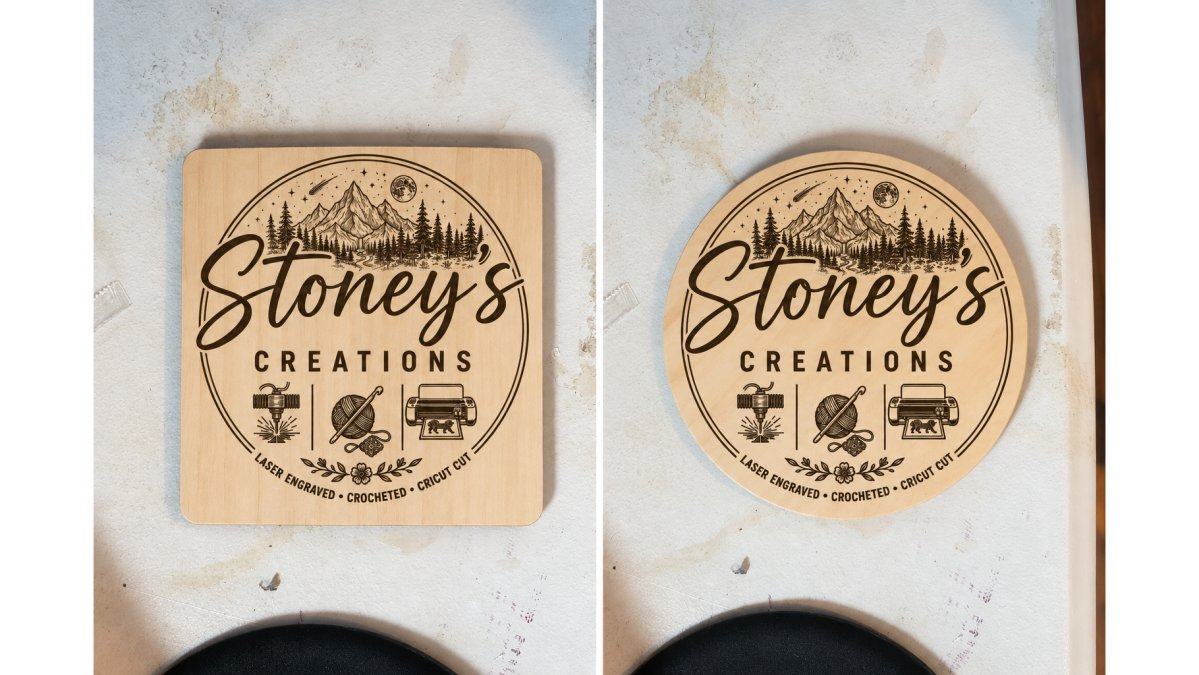
Custom Laser-Engraved Wood Coasters: Personalized Detail for Daily Use
Starting at $18.00, these coasters turn any design into a one-of-a-kind set. Send a family name, monogram, logo, or quote, and the team laser-engraves it into real wood with precision that captures fine detail. The engraving burns permanently into the grain, so it never fades or wears off. Available in square or round shapes, these work well for housewarming gifts, wedding favors, and business branding.
Custom Engraved Slate Coasters: Natural Texture for Rustic Homes
For a more organic look, the custom engraved slate coasters come in sets of two or four starting at $21.00. Each natural slate piece has its own unique shape and texture, so no two sets are ever exactly alike. The laser engraving stands out against the dark stone, fitting cabin, farmhouse, or mountain-inspired decor. These make thoughtful housewarming gifts or a simple upgrade for your own coffee table.
Custom Laser-Engraved Live Edge Wood Art: A Statement Piece
When you want something that commands attention, live edge wood art starts at $90.00 and scales with design complexity. The team engraves landscape scenes, family names, logos, or memorial pieces onto natural live edge wood, keeping the grain and organic edges intact. Because every slab carries different grain patterns, no two pieces are identical. This is the option for anniversaries, memorials, or a statement piece above a fireplace mantel.
Custom Vinyl Decals & Stickers: Affordable Personalization
At $7.00 and up, custom vinyl decals offer the most budget-friendly entry into personalization. These are cut and weeded by hand, not mass-produced, and come in finishes from standard colors to glitter, glow-in-the-dark, and holographic vinyl. Built from outdoor-rated permanent vinyl, they hold up on car windows, laptops, tumblers, and mirrors, great for small-batch gifts or stocking stuffers.
Engraving vs Etching: What Is the Difference for Your Gift?
Understanding the difference between engraving and etching directly determines how your gift will look, feel, and hold up over years of use. The method used is the single biggest factor in the final product's quality and longevity.
Engraving is a physical process that cuts into the material's surface to create a recessed design, usually done with a laser that vaporizes the material or a diamond drag bit that displaces it. Etching, by contrast, is a chemical process that uses acid to eat away at the surface. For most personalized gifts, laser engraving is superior because it produces a crisp, permanent mark that withstands handling, washing, and time.
How Different Materials Respond to Engraving
The real-world difference emerges when you look at how these methods interact with specific materials, the difference between a keepsake and a regret.
Hardwoods (Maple, Oak, Walnut): Laser engraving produces a clean, high-contrast mark with a subtle toasted burn. The depth is shallow, a few hundredths of an inch, but the dense wood keeps the mark crisp for decades. The primary risk is the finish; an unsealed engraving can absorb moisture and stain. Look for pieces sealed with a food-safe, water-based polyurethane or hard wax oil if used for food service.
Softwoods (Pine, Cedar): These engrave quickly and with high contrast, but they are less durable. The uneven grain makes the laser burn deeper into softer spring wood and shallower into harder summer wood, creating a slightly wavy line, a characteristic, not a defect. Softwoods are more prone to dents and scratches, making them better for decorative wall art than daily-use items.
Slate: Laser engraving on this metamorphic rock produces a striking white or light gray mark against the dark stone, creating a frosted, slightly raised effect as the laser fractures surface crystals. Slate is naturally heat-resistant and waterproof, making it excellent for coasters and trivets. The engraving is effectively permanent, though the slate itself can chip if dropped.
Glass and Crystal: A standard CO2 laser creates a permanent, frosted mark by fracturing the surface at a microscopic level, but it is shallow. For deeper, tactile engraving, artisans use a rotary diamond burr, which is slower and more expensive but produces a mark you can feel. For crystal awards, the diamond drag method is the industry standard because it creates a precise, chip-free line without stress fractures.
Metal (Stainless Steel, Aluminum, Brass): Bare metals reflect standard laser beams, so professional shops use a fiber or diode-pumped laser that metals absorb, or apply a marking compound first. The result is a dark, permanent oxide layer bonded to the metal, a surface transformation highly resistant to abrasion and corrosion. On softer metals like brass, laser engraving can produce a slight relief effect.
Why This Matters for Your Purchase
When a product listing says "engraved" without specifying the method, ask questions. A cheap import may use a low-power laser that only scorches soft wood, leaving a mark that fades within a year. A quality artisan will specify their equipment and adjust settings for each material. This attention to detail separates a printed-on look from one that looks like it grew there.
The Trade-Off Between Aesthetics and Longevity
The most durable engraving is not always the most beautiful. Deep engraving on wood creates a strong shadow effect but can burn away fine details; shallow engraving preserves detail but may be less visible. A skilled artisan balances these factors. The craft behind a handmade piece often involves careful consideration of these details.
Understanding these mechanisms allows you to make an informed choice rather than relying on marketing language. When you buy custom engraved gifts online, you are buying a set of material properties and a production process. Knowing the difference between a laser burn on pine and a diamond drag cut on crystal helps you select a gift that matches the recipient's lifestyle.
Why Custom Laser Engraved Wood Gifts Feel More Meaningful
The emotional appeal of wood engraving is real, but it is not just sentimentality. There are tangible, physical reasons why a laser-engraved wood gift feels different from a printed mug or plastic trophy.
The Tactile and Visual Signature of Burned Wood
Laser engraving on wood transforms the material itself. The laser heats the wood to vaporization, creating a char zone that produces two effects printed items cannot replicate. First, the engraved area is recessed, so you can feel the design, a tactile quality that makes the gift feel more crafted. Second, the charring creates a natural contrast that shifts with the light, catching shadows in a way flat printing never does. This is why a wooden cutting board with a family name feels like an heirloom, while a printed photo mug feels like a promotional item.
Grain as a Fingerprint
No two pieces of wood are identical, the grain, color, knots, and live edge are unique to each slab. When you engrave a name or date into that surface, you create an object that exists nowhere else. This is not a marketing claim; it is a physical fact. This inherent uniqueness elevates the gift from a commodity to an artifact: the recipient receives the only cutting board in existence with that grain pattern and that message.

The Comparative Advantage Over Other Materials
Wood holds a specific advantage over glass, metal, and acrylic in emotional resonance. Glass is beautiful but cold; metal is durable but impersonal; acrylic can feel cheap. Wood is warm, organic, and alive, aging gracefully with a patina over time. A wooden gift used daily, a cutting board, coaster, or serving tray, shows wear that tells a story: scratches, water rings, and smoothing from handling become part of the object's history. The gift does not just commemorate a moment; it participates in the daily life that follows.
The Psychology of Natural Materials
Research in environmental psychology suggests humans have an innate affinity for natural materials, a concept known as biophilia, where exposure to wood grain reduces stress and increases well-being. The practical implication is clear: a gift made from a natural material is more likely to be kept in a prominent place and used regularly than one made from synthetics. A wooden gift invites touch and becomes part of the home's sensory environment.
The Role of Imperfection
Mass-produced gifts are designed to be flawless, identical, smooth, and uniform. Wood resists this uniformity: a live edge retains the tree's contour, and a knot may appear in the middle of a design. These are not flaws; they are evidence of the material's origin. Giving a wooden gift acknowledges that authenticity, not perfection, is the goal, a message that resonates because it suggests the giver values the recipient's unique character over a generic ideal.
Why This Matters When You Buy Custom Engraved Gifts Online
When you shop online, you cannot touch the wood, so understanding what to look for matters more. High-resolution photos showing the grain up close are a good sign; videos demonstrating the engraving process are even better. A seller who discusses the specific wood they use, and why, demonstrates expertise that translates into a better product.
The Benefits of Small-Batch Handmade Gifts for Quality and Sentiment
Small-batch handmade gifts offer quality control that mass production cannot match. When an artisan engraves each piece individually, they inspect the wood grain and catch flaws before they reach the customer.
There is a growing shift toward small-batch artisanal engraving, with retailers emphasizing craftsmanship for milestones like weddings and housewarmings (Prize Possessions, 2025). Consumers increasingly want to support makers over factories and will pay more for pieces with a human touch. The benefits extend beyond the product: you support a craftsperson, preserve traditional skills, and receive an item made with intention rather than assembled on a line.
How to Ensure Quality When You Buy Engraved Items Online
Before you buy custom engraved gifts online, consider material durability. Slate is naturally heat-resistant for coasters and trivets.
Turnaround time is another factor. Handmade pieces take time and rush orders can compromise quality. If you need a gift by a specific date, order early and communicate the deadline.
| What to Check | Why It Matters | What to Look For |
|---|---|---|
| Material durability | Determines how long the gift lasts | Sealed wood, natural slate, food-safe finishes |
| Engraving precision | Affects how the design reads | Fine detail, crisp text, consistent depth |
| Turnaround time | Ensures the gift arrives on schedule | Clear production windows, made-to-order policies |
| Craftsmanship | Separates keepsakes from cheap goods | Handmade, small-batch, individual inspection |
Conclusion: Give a Gift They Will Actually Keep
A generic gift gets appreciated once and forgotten. A custom engraved piece becomes part of the recipient's home and daily life. Personalization drives emotional connection, and quality materials ensure the piece lasts long enough to matter. When you buy custom engraved gifts online, choose a maker who treats each order as a unique piece rather than a batch item.
Stoney's Creations crafts every laser-engraved wood and slate item by hand in small batches, inspired by the mountains and forests of New Hampshire. Each piece is made to order, so your design, name, or message becomes part of the natural material itself. Shop the collection and give a gift that will still be on display years from now.
Frequently Asked Questions
What is the best website for personalized gifts?
The best website depends on the material and style you want. For custom laser engraved wood gifts, look for small-batch studios that show real photos of their work and craft in-house. Stoney's Creations, for example, offers handmade wooden coasters starting at $18, live edge wood art from $90, and slate coasters from $21, all made to order. A dedicated maker will usually provide better communication and quality control than a large marketplace.
How do I ensure quality when buying engraved items online?
Look for three things: material, process, and proof. Check that the wood or slate is sealed for durability against daily use and moisture. Finally, look for real customer photos and clear policies on damage or returns. A reputable small shop should answer design questions before you order.
What is the difference between engraving and etching?
Engraving cuts physically into the material, creating a groove that is durable and tactile. Etching uses chemicals or a laser to remove surface material, which can be shallower.
Can I order custom engraved gifts online with fast turnaround?
Yes, but turnaround varies by studio. Many small-batch makers require extra time for design and hand-finishing. When you order, check the stated production time and communicate your deadline in the order notes. If you need a gift by a specific date, ask the maker directly before purchasing. Made-to-order items often ship within a few business days, but custom artwork may take longer.